Get In Touch
Have you ever wondered why the same portfolio that performed brilliantly for two years suddenly starts underperforming, even though you haven't changed a single thing?
That's because the Market Changed, and your Portfolio did too.
But markets don't move in one direction forever. And it’s hard to predict which phase comes next. Yet, PMS fund managers understand which phase you're in and adjust your portfolio accordingly.
Stay tuned as we explore the four major market cycles, what works in each, how professional portfolio managers think about these shifts, and the mistakes investors make when they don't adapt.
This read is what your portfolio needs!
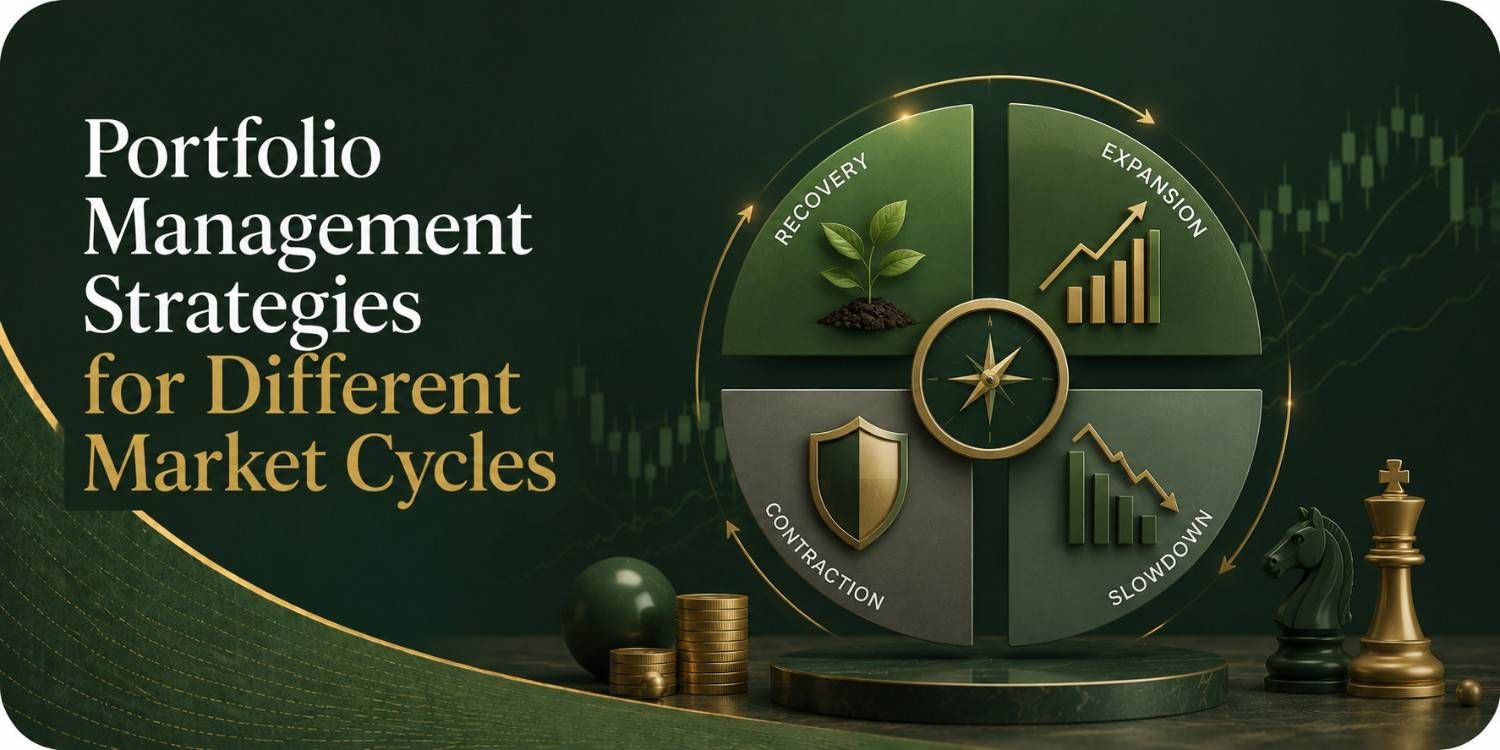
Markets generally move through four major phases, namely bull, bear, recovery, and sideways. Each is defined by distinct price behaviour, investor sentiment, and the type of portfolio strategy that tends to perform best during that period.
Here are the top cycles often seen in the market:
In the bull market, stock prices rise over a sustained period, supported by improving earnings, economic growth, and positive investor sentiment. Here, investor confidence is mostly high. In this phase, the primary focus is “Growth.”
In contrast to bull markets, bear markets witness a fall in share prices from recent highs, often within weeks or months. During such a period, fear dominates, and defensive sectors (pharma, FMCG, utilities) outperform. And to protect the portfolio, fund managers' primary focus is capital protection.
The recovery phase begins after a prolonged decline, when economic conditions start improving, and markets begin to recover. But sentiment is still cautious, and volumes are low.
Most investors are still sitting on losses from the bear phase. Here, the primary focus is early positioning for growth.
In the sideways market, no clear trend is visible. For eg., the Nifty trades within a certain range for weeks or months. Neither bulls nor bears are in control. Even sector rotation is common.
Honestly, the only reason why portfolio strategy must change with markets is that the same allocation that works in a bull market can significantly erode portfolio value in a bear market. And the portfolio that protects you during a downturn may underperform during a recovery if you don't adjust it.
Static portfolios assume the market behaves the same way every year. It doesn't. Portfolio strategy should reflect the current phase, not the phase you wish it were.
Let’s understand with a simple example.
An investor’s portfolio with 90% in mid-cap and small-cap equity may perform well during a bull run. But when the bear market hits, those same mid-caps can decline sharply, sometimes by 40% or even more, wiping out gains in a few months.
Portfolio fund managers may deploy various portfolio management strategies across different market cycles.
Here are a few of the portfolio allocation strategies applicable to PMS:
Most PMS providers in India follow an active investment approach, using research-driven stock selection and periodic portfolio rebalancing to seek opportunities across different market cycles. Hence, it is relatively uncommon style seen in the PMS space.
Professional portfolio managers don't react emotionally to market cycles. Instead, they use a systematic framework that combines;
Additionally, PMS fund managers also monitor:
Including these factors in target cycle investing shifts allocations gradually rather than making sudden, all-or-nothing moves.
Before making any allocation shift in your portfolio, ask:
If any answer feels uncertain, the right move is usually to consult a professional before making any dramatic change.
For investors with ₹50 lakh+ in equity, professional management through a SEBI-registered PMS can provide the discipline and cycle-awareness that self-managed portfolios often lack.
Here, the fund manager monitors market cycles full-time, adjusts allocations systematically, and removes the emotional decision-making that costs most retail investors their returns.
Apart from that, a professional manager also:
For investors with 50+ lakhs, or those who build wealth across multiple cycles, it’s hard to predict the next phase. That’s when understanding market cycles and their impact on your portfolio is important.
Understanding market cycles won't eliminate losses. But it can help you avoid the most expensive mistake in investing. It also aligns with the objective of Portfolio Management Services (PMS).
Markets generally move through four phases: bull market (rising prices, high confidence), bear market (falling prices, fear), recovery (bottoming out, early gains), and sideways (range-bound, no clear trend). Each phase rewards different portfolio strategies.
Disclaimer:
The information provided in this article is for educational and informational purposes only. Any financial figures, calculations, or projections shared are solely intended to illustrate concepts and should not be construed as investment advice. All scenarios mentioned are hypothetical and are used only for explanatory purposes. The content is based on information obtained from credible and publicly available sources. We do not guarantee the completeness, accuracy, or reliability of the data presented. Any references to the performance of indices, stocks, or financial products are purely illustrative and do not represent actual or future results. Actual investor experience may vary. Investors are advised to carefully read the scheme/product offering information document before making any decisions. Readers are advised to consult with a certified financial advisor before making any investment decisions. Neither the author nor the publishing entity shall be held responsible for any loss or liability arising from the use of this information.